Strategic Media Relations and Crisis Communication Training Course
Course Overview:
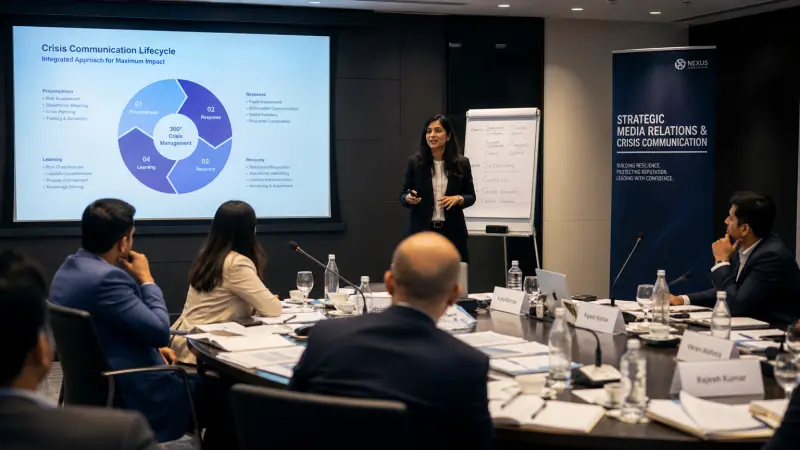
The Strategic Media Relations and Crisis Communication Training Course is a practical five-day programme designed for PR professionals responsible for protecting organizational reputation, managing media relationships, and coordinating communication during high-pressure situations. The course integrates Media Relations Training Course content with the essential principles of a Media Crisis Management Course, PR Planning Training, and Strategic Communication Planning.
Participants learn how to build productive relationships with journalists, understand changing media expectations, develop credible messages, prepare spokespersons, and manage proactive and reactive communication. The programme also addresses the complete communication planning cycle: situation analysis, audience identification, SMART objectives, strategy, tactics, implementation, and evaluation. These elements reflect established public relations planning approaches in which research, strategy, tactics, and evaluation form a connected process.
The course places particular emphasis on crisis readiness. Participants examine pre-crisis preparation, first-response communication, media coordination, stakeholder engagement, rumour control, and reputation recovery. Crisis communication planning is treated as an operational discipline involving spokesperson selection, message preparation, approval procedures, stakeholder alliances, and response protocols.
Through Media Interview Training, Spokesperson Training Course activities, crisis simulations, and PR Campaign Planning exercises, participants develop practical Media Engagement Skills that can be applied immediately within corporate communications, public relations, government communication, and stakeholder management functions.
Target Audience:
- Public Relations Managers and PR Officers
- Corporate Communications Managers and Specialists
- Media Relations Managers and Press Officers
- Communication Strategy and Campaign Managers
- Crisis Communication and Reputation Management Professionals
- Corporate Affairs and External Relations Managers
- Public Information Officers and Government Communicators
- Spokespersons and Senior Executives who engage with the media
- Marketing Communications and Brand Managers
Targeted Organizational Departments:
- Public Relations and Media Relations
- Corporate Communications and Corporate Affairs
- Marketing Communications and Brand Management
- Crisis Management and Business Continuity
- Executive Office and Leadership Communications
- Government Relations and Public Affairs
- Stakeholder Engagement and Community Relations
- Digital Communications and Social Media
- Internal Communications and Employee Engagement
- Legal, Compliance, and Risk Management
Targeted Industries:
- Government Ministries, Authorities, and Public Institutions
- Banking, Financial Services, and Insurance
- Oil, Gas, Energy, and Utilities
- Healthcare, Pharmaceuticals, and Public Health
- Telecommunications and Technology
- Aviation, Transport, and Logistics
- Construction, Engineering, and Infrastructure
- Hospitality, Tourism, and Events
- Education, Universities, and Research Institutions
- Retail, Consumer Goods, and E-commerce
- Nonprofit, Humanitarian, and International Organizations
- Media, Entertainment, and Creative Industries
Course Offerings:
By the end of this course, participants will be able to:
- Develop practical media relations and communication strategies.
- Build professional relationships with journalists and media outlets.
- Create key messages, press statements, media pitches, and briefing notes.
- Prepare spokespersons for television, radio, print, and digital interviews.
- Manage difficult questions, misinformation, and media scrutiny.
- Develop crisis communication plans and first-response procedures.
- Coordinate communication with leadership, legal teams, operations, and stakeholders.
- Measure media coverage, message penetration, sentiment, and reputation outcomes.
Training Methodology:
The Strategic Media Relations and Crisis Communication Training Course uses an applied learning approach built around realistic corporate communication challenges. Short facilitator-led sessions introduce essential concepts from Media Relations Training Course, Crisis Communication Training, Reputation Management Training, and Strategic Communication Planning. These sessions are followed by practical exercises that require participants to apply each concept to workplace situations.
Participants work individually and in groups to analyze media environments, segment stakeholders, define communication objectives, develop message frameworks, and prepare media-response materials. The PR Campaign Planning component follows a structured process covering situation analysis, challenge statements, goals, audiences, objectives, strategies, tactics, timelines, budgets, and evaluation. This reflects established public relations planning models that connect organizational analysis with campaign implementation and measurement.
Case studies, press conference simulations, role-play, peer review, group presentations, and facilitated reflection sessions ensure that participants leave with practical decision-making skills rather than theoretical knowledge alone.
Course Toolbox:
Participants will receive guidance and examples relating to:
- Media relations strategy and media mapping
- PR and communication planning frameworks
- Key message and talking-point formats
- Press release and media briefing structures
- Interview and spokesperson preparation checklists
- Crisis communication plan structure
- Holding statement and crisis FAQ examples
- Stakeholder and reputation risk mapping
- Media monitoring and evaluation formats
- Post-crisis review checklist
Course Agenda:
Day 1: Strategic Media Relations and the Modern Media Environment
- Topic 1: The Strategic Role of Media Relations in Corporate Communications
- Topic 2: Understanding Journalists, Newsrooms, Editorial Priorities, and Deadlines
- Topic 3: Mapping Traditional, Digital, Regional, and Specialist Media Channels
- Topic 4: Identifying News Value, Media Opportunities, and Reputation Risks
- Topic 5: Building Ethical and Productive Relationships with Journalists
- Topic 6: Designing a Proactive and Reactive Media Relations Operating Model
- Reflection & Review: Assess the organization’s current media engagement approach and identify priority improvements.
Day 2: PR Planning and Strategic Communication Design
- Topic 1: Conducting Situation, Organization, Reputation, and Media Environment Analysis
- Topic 2: Mapping Stakeholders, Publics, Influencers, and Priority Audiences
- Topic 3: Establishing SMART Communication and Reputation Objectives
- Topic 4: Developing Core Narratives, Key Messages, and Audience-Specific Positioning
- Topic 5: Selecting Strategies, Tactics, Channels, Timelines, and Responsibilities
- Topic 6: Integrating Media Relations, Digital Communication, and Stakeholder Engagement
- Reflection & Review: Build the strategic foundation for a PR or corporate communication plan.
Day 3: Media Content, Interviews, and Spokesperson Performance
- Topic 1: Writing Media Pitches, Press Releases, Statements, and Briefing Notes
- Topic 2: Translating Complex Organizational Information into Clear Media Messages
- Topic 3: Preparing Executives and Subject-Matter Experts for Media Engagement
- Topic 4: Managing Television, Radio, Print, Online, and Remote Interviews
- Topic 5: Handling Difficult, Hostile, Speculative, and Repetitive Questions
- Topic 6: Conducting Press Conferences, Media Briefings, and Announcement Events
- Reflection & Review: Deliver a simulated media interview and receive structured feedback.
Day 4: Crisis Communication Planning and Media Response
- Topic 1: Understanding Crisis Types, Escalation Triggers, and Reputation Exposure
- Topic 2: Building the Crisis Communication Team, Roles, Authorities, and Approval Protocols
- Topic 3: Preparing Crisis Scenarios, Holding Statements, FAQs, and Message Templates
- Topic 4: Managing the First 24–48 Hours of a Crisis Media Response
- Topic 5: Addressing Rumours, Misinformation, Social Media Pressure, and Conflicting Reports
- Topic 6: Coordinating Leadership, Legal, Operations, Stakeholders, and Media Communications
- Reflection & Review: Conduct an initial-response simulation based on an evolving crisis scenario.
Day 5: Reputation Recovery, Campaign Integration, and Communication Evaluation
- Topic 1: Managing Sustained Media Scrutiny During the Crisis Maintenance Phase
- Topic 2: Communicating Corrective Action, Recovery Progress, and Organizational Accountability
- Topic 3: Restoring Trust and Strengthening Corporate Reputation after a Crisis
- Topic 4: Measuring Media Coverage, Sentiment, Message Penetration, and Stakeholder Response
- Topic 5: Developing an Integrated Media Relations and Crisis Communication Plan
- Topic 6: Presenting and Defending the Final Communication Strategy
- Reflection & Review: Consolidate lessons learned and define individual workplace application priorities.
FAQ:
What specific qualifications or prerequisites are needed for participants before enrolling in the course?
No formal academic qualifications are required. The course is most suitable for participants with responsibilities in public relations, corporate communication, media relations, public affairs, marketing communication, reputation management, stakeholder engagement, or crisis response. Basic professional experience in communication or organizational affairs is helpful but not essential.
How long is each day's session, and is there a total number of hours required for the entire course?
Each day's session is generally structured to last around 4–5 hours, with breaks and interactive activities included. The total course duration spans five days, approximately 20–25 hours of instruction.
What is the difference between a crisis communication plan and a general communication plan?
A general communication plan supports ongoing organizational objectives through planned audiences, messages, channels, activities, timelines, and evaluation. A crisis communication plan is designed for high-pressure situations involving uncertainty, operational disruption, reputational risk, and urgent stakeholder information needs.
It includes crisis-specific components such as activation criteria, response roles, spokesperson arrangements, rapid approval procedures, holding statements, stakeholder notification, media enquiry management, monitoring, and communication continuity. Crisis planning also addresses different phases, from pre-crisis preparation through initial response, maintenance, resolution, and post-crisis evaluation.
How This Course is Different from Other Strategic Media Relations and Crisis Communication Courses:
This course stands out because it combines day-to-day media relations, strategic public relations planning, spokesperson performance, crisis response, and reputation recovery within one integrated corporate communication framework. Many programmes treat these subjects separately. This course demonstrates how research, audiences, objectives, messages, tactics, media engagement, crisis readiness, and evaluation must operate as one connected system.
The programme is strongly workplace-oriented. Participants do not only discuss media relations principles; they prepare practical communication materials, analyze stakeholder expectations, develop strategic plans, conduct simulated interviews, respond to difficult questions, and manage an evolving crisis scenario. The course therefore develops both strategic judgment and operational capability.
Another distinguishing feature is its treatment of the modern media environment. It considers traditional journalism, digital news, social media, rapid information cycles, fragmented audiences, misinformation, and direct stakeholder communication. It also recognizes that credible media relations require understanding the journalist’s independent role rather than attempting to control coverage.
Finally, the course emphasizes measurable communication outcomes. Participants learn to move beyond counting press releases or media mentions and assess message penetration, stakeholder understanding, sentiment, behavioural response, reputation effects, and organizational value. This creates a practical Public Relations and Communications Course suitable for professionals who must advise leaders, manage high-stakes communication, and demonstrate results.
credits: 5 credit per day
Course Mode: full-time
Provider: Agile Leaders Training Center
-
Events for this Course
-
Athens 28 Sep - 02 Oct 2026
-
Amsterdam 05 - 09 Oct 2026
-
Madrid 12 - 16 Oct 2026
-
Seoul 12 - 16 Oct 2026
-
Kuwait 18 - 22 Oct 2026
-
Paris 19 - 23 Oct 2026
-
Prague 26 - 30 Oct 2026
-
London 02 - 06 Nov 2026
-
Amman 08 - 12 Nov 2026
-
Kuala Lumpur 16 - 20 Nov 2026
-
Manama 22 - 26 Nov 2026
-
Istanbul 30 Nov - 04 Dec 2026
-
Muscat 06 - 10 Dec 2026
-
Amsterdam 07 - 11 Dec 2026
-
Dubai 14 - 18 Dec 2026
-
Baku 21 - 25 Dec 2026
-
Tokyo 25 - 29 Jan 2027
-
Tbilisi 08 - 12 Feb 2027
-
Milan 15 - 19 Feb 2027
-
Vienna 01 - 05 Mar 2027
-
Barcelona 15 - 19 Mar 2027
-
Cape town 21 - 25 Mar 2027
-
Casablanca 29 Mar - 02 Apr 2027
-
Dubai 05 - 09 Apr 2027
-
Madrid 12 - 16 Apr 2027
-
Paris 19 - 23 Apr 2027
-
Manama 25 - 29 Apr 2027
-
Cairo 03 - 07 May 2027
-
Rome 10 - 14 May 2027
-
London 17 - 21 May 2027
-
Doha 23 - 27 May 2027
-
Dubai 31 May - 04 Jun 2027
-
Sharm El-Sheikh 07 - 11 Jun 2027
-
Kuala Lumpur 14 - 18 Jun 2027
-
Vienna 28 Jun - 02 Jul 2027
-
Zoom 05 - 09 Jul 2027
-
Amsterdam 12 - 16 Jul 2027
-
Barcelona 19 - 23 Jul 2027
-
Jakarta 26 - 30 Jul 2027
-
Istanbul 02 - 06 Aug 2027
-
Cairo 09 - 13 Aug 2027
-
Milan 16 - 20 Aug 2027
-
London 30 Aug - 03 Sep 2027
-
Rome 06 - 10 Sep 2027
-
Dubai 13 - 17 Sep 2027
-
Johannesburg 26 - 30 Sep 2027
| Image | Location | Dates | Duration | Mode | Price | Actions |
|---|---|---|---|---|---|---|

|
Athens |
Week 40, 2026 28 Sep - 02 Oct 2026 |
5 Days | Onsite | €6,700 | |

|
Amsterdam |
Week 41, 2026 05 - 09 Oct 2026 |
5 Days | Onsite | €5,700 | |

|
Madrid |
Week 42, 2026 12 - 16 Oct 2026 |
5 Days | Onsite | €5,700 | |

|
Seoul |
Week 42, 2026 12 - 16 Oct 2026 |
5 Days | Onsite | €10,000 | |

|
Kuwait |
Week 42, 2026 18 - 22 Oct 2026 |
5 Days | Onsite | €5,500 | |

|
Paris |
Week 43, 2026 19 - 23 Oct 2026 |
5 Days | Onsite | €5,700 | |

|
Prague |
Week 44, 2026 26 - 30 Oct 2026 |
5 Days | Onsite | €6,000 | |

|
London |
Week 45, 2026 02 - 06 Nov 2026 |
5 Days | Onsite | €5,700 | |

|
Amman |
Week 45, 2026 08 - 12 Nov 2026 |
5 Days | Onsite | €4,100 | |

|
Kuala Lumpur |
Week 47, 2026 16 - 20 Nov 2026 |
5 Days | Onsite | €5,200 | |

|
Manama |
Week 47, 2026 22 - 26 Nov 2026 |
5 Days | Onsite | €4,700 | |

|
Istanbul |
Week 49, 2026 30 Nov - 04 Dec 2026 |
5 Days | Onsite | €4,500 | |

|
Muscat |
Week 49, 2026 06 - 10 Dec 2026 |
5 Days | Onsite | €5,700 | |
|
|
Amsterdam |
Week 50, 2026 07 - 11 Dec 2026 |
5 Days | Onsite | €5,700 | |

|
Dubai |
Week 51, 2026 14 - 18 Dec 2026 |
5 Days | Onsite | €4,500 | |

|
Baku |
Week 52, 2026 21 - 25 Dec 2026 |
5 Days | Onsite | €5,000 | |

|
Tokyo |
Week 04, 2027 25 - 29 Jan 2027 |
5 Days | Onsite | €10,000 | |

|
Tbilisi |
Week 06, 2027 08 - 12 Feb 2027 |
5 Days | Onsite | €5,000 | |

|
Milan |
Week 07, 2027 15 - 19 Feb 2027 |
5 Days | Onsite | €5,700 | |

|
Vienna |
Week 09, 2027 01 - 05 Mar 2027 |
5 Days | Onsite | €5,700 |
Frequently asked questions
What does this course cover?
Course Overview:The Strategic Media Relations and Crisis Communication Training Course is a practical five-day programme designed for PR professionals responsible for protecting organizational reputation, managing media relationships, and coordinating communication during high-pressure situations. The course integrates Media Relations Training Course cont…
Are training dates available?
Yes. Available dates and destinations are listed in the course dates section on this page.
How can I register?
Choose an available date on this page and complete the registration form, or send a programme enquiry.
Can I download the course brochure?
Yes. Use the brochure download link provided on this page.
